Attic Spray Foam Insulation
Roof-deck and attic-floor foam, the highest-ROI insulation upgrade for Cincinnati homes.
Typical$2,800-$8,500
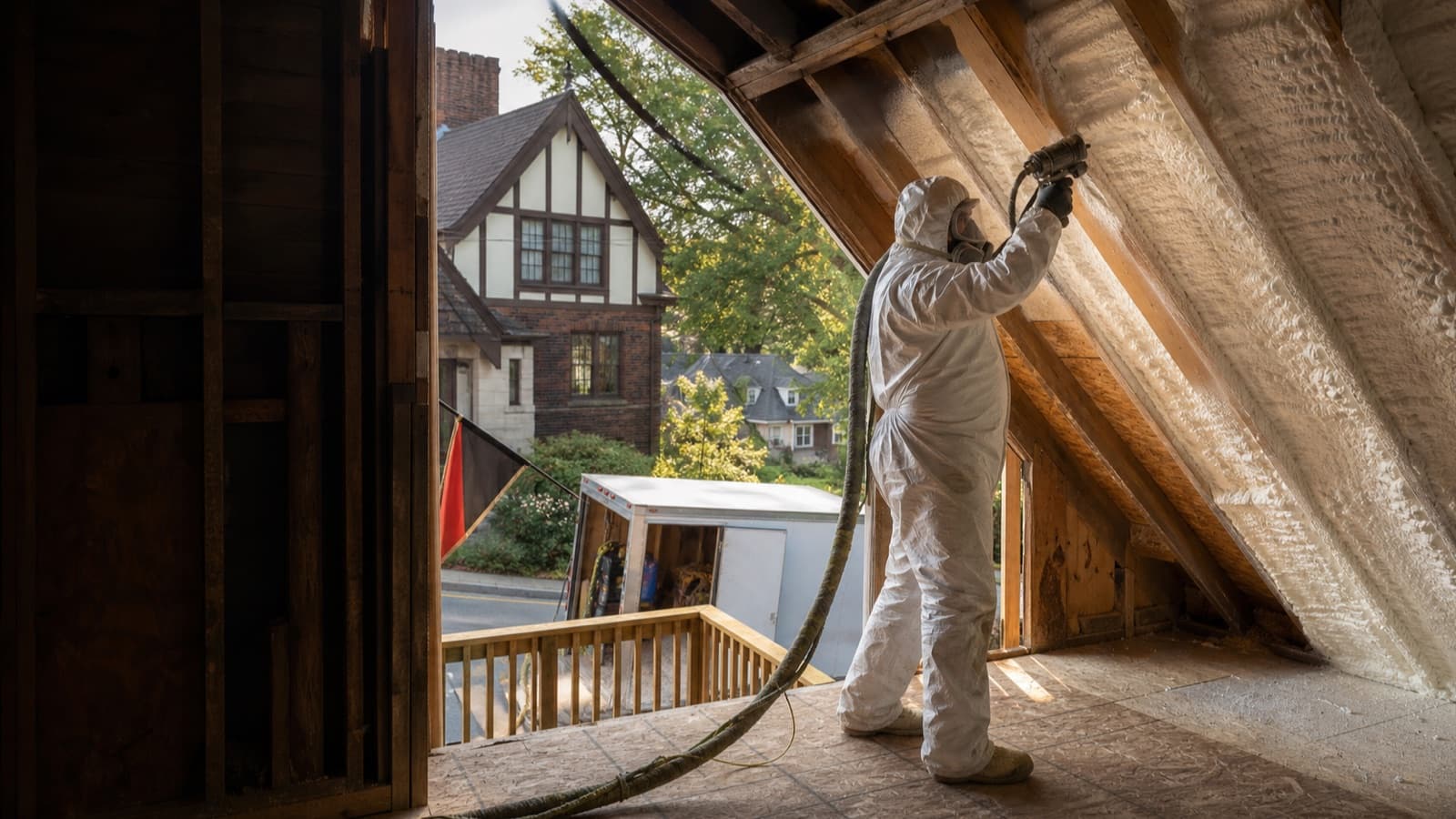
BPI-credentialed spray foam installs across Greater Cincinnati since 2019. Closed-cell, open-cell, and hybrid spray foam for attics, walls, crawl spaces, and rim joists. Most jobs complete in 1-2 days with a manufacturer-stamped closeout package.
Step 1
The Cincinnati-area installer measures square footage, evaluates access, and writes a fixed-price quote on the same visit.
Step 2
Closed-cell vs. open-cell, attic vs. wall, ventilation strategy, designed around your home and HVAC layout.
Step 3
Crew arrives with truck-mounted spray rig. Most jobs complete in a single day; whole-home retrofits take 2-3.
Step 4
Manufacturer-stamped product data, R-value certification per surface, square footage covered, and itemized invoice for your records and any current state or utility rebate program.
Closed-cell spray foam vs. R-3.5 for fiberglass batts: twice the insulation per inch of cavity space.
Source: US Department of Energy
Typical payback window on a Cincinnati attic-plus-rim-joist closed-cell foam package, on utility savings alone, before factoring resale-value or comfort.
Heating and cooling savings achievable through proper air sealing and insulation in Climate Zone 4 homes (Cincinnati region).
DOE Energy Saver guide to insulation types, R-values, and recommended applications.
Section 25C credit terminated December 31, 2025 under the One Big Beautiful Bill Act, Public Law 119-21. Background page maintained by IRS for projects placed in service before that date.
Energy Star recommendations for attic and wall insulation R-values by climate zone.
The Building Performance Institute credentials spray foam Cincinnati installers.
Every job comes with a written quote and no-pressure consultation. Workmanship warranty terms are set by your lead technician and confirmed before work begins.
Roof-deck and attic-floor foam, the highest-ROI insulation upgrade for Cincinnati homes.
Retrofit and new-construction wall foam. Air seal + R-value in one step.
Closed-cell foam encapsulation. Moisture barrier + insulation + air seal.
Closed-cell spray foam in Cincinnati: R-7 per inch, integrated vapor barrier above 2 inches, and structural rigidity for crawl spaces, rim joists, and below-grade work.
R-3.7 per inch. Vapor permeable. Better sound dampening. Lower cost.
Pole barns, workshops, garages. Eliminates condensation and sound.
The single highest-ROI air-sealing project in any Cincinnati home.
We offer $50 off any spray foam insulation project for veterans, active military, first responders, and seniors 65 and older. Mention it when you call or text us.
Mention this offer when you call
(513) 848-6476“1928 Tudor with cold upstairs every winter, downstairs/upstairs delta of 18 degrees. Closed-cell on the roof deck and rim joist plus knee-wall back-side spray. Post-install delta is 5 degrees and our December gas bill dropped from $342 to $221. Crew was clean, paperwork was complete.”
“Drill-and-fill closed-cell into 1925 plaster walls. We were terrified about the patches showing. Their plaster restoration specialist was on site for the patching and you genuinely cannot tell where the access holes were. ACH50 went from 11.4 to 4.8. Whole house is quieter, too.”
“Whole-home foam on a new custom build during framing. Three site visits, ~4.5 days of crew time spread across 30 calendar days, no coordination conflicts with other trades. Post-build blower-door at 1.4 ACH50, HVAC equipment downsized after foam, $4,200 in equipment savings. They knew what they were doing.”
These reflect real situations from homeowners across our network. Names and some identifying details are adjusted to protect homeowner privacy while keeping the point of each story intact.



Cincinnati sits in IECC Climate Zone 4A, the moist mixed-humid corridor that runs from Indianapolis through Cincinnati and Pittsburgh to the Atlantic. Two characteristics dominate the energy load: heating-degree-days run roughly 4,500-4,800 annually (cold enough that any winter air leakage is expensive) and summer dew points sit in the high 60s to low 70s for weeks at a time (humid enough that any cooling air leakage is doubly expensive because of the latent load).
Pre-1980 Cincinnati housing stock typically has empty wall cavities (no insulation at all in 1920s American Foursquares and Tudor-era homes; R-7 to R-11 fiberglass batts in 1950s-1970s ranches). Attics range from 4-12 inches of decades-compacted blown cellulose. The federal R-value targets for Zone 4-8 set by Energy Star are R-49 in the attic, R-13 to R-21 in walls, R-19 to R-30 in floors over unconditioned space, and R-13 to R-19 in basement walls. Most Cincinnati homes built before 1995 hit none of those targets out of the box.
Closed-cell spray foam delivers R-7 per inch (versus R-3.5 for fiberglass and R-3.7 for cellulose) plus an integrated air barrier and, at 2+ inches thickness, a vapor barrier. That triple property is what distinguishes foam from cheaper insulation: in a Climate Zone 4 home with high winter air leakage and high summer humidity, the air-seal-plus-vapor properties matter more than the raw R-value, especially in the rim-joist band. A typical Cincinnati attic-plus-rim-joist package cuts heating-and-cooling load by 25-45% per DOE Energy Saver modeling, with payback under 7 years on Cincinnati utility rates.
Every credentialed Cincinnati spray foam install should end with a closeout package delivered to the homeowner within 7 business days of final spray. The package is small (a manila folder or PDF bundle) but matters out of proportion to its size. It is the only durable record of what was actually installed, where, and at what specification.
A complete closeout package contains: (1) manufacturer-stamped product data sheets identifying the open-cell or closed-cell formulation by brand (Demilec, Icynene, BASF) and product family, (2) R-value certification showing the as-built R per inch and total R per surface, (3) square-footage map of treated areas with photos before-and-after for each surface, (4) line-item invoice separating product cost, labor, and any non-foam scope (drywall, demolition, HVAC modification), (5) penetration-seal photos for chimney chase, recessed lights, plumbing stacks, and bath fan housings, (6) the written workmanship warranty terms, and (7) ICC-ES product evaluation report numbers for the foam used (ESR-3375 for Icynene, ESR-1826 for Demilec Heatlok, etc).
The closeout package matters for four reasons. First, resale: documented foam installs typically command modest premiums on the Cincinnati MLS, but only when the buyer's appraiser can verify the install. Second, tax and rebate programs: the federal Section 25C insulation credit ended December 31, 2025 (per the One Big Beautiful Bill Act, Public Law 119-21), but state, utility, and any future federal programs all require the same closeout documentation, and Cincinnati homeowners completing foam projects in 2026 should ask their CPA about Ohio state programs and Duke Energy or CenterPoint Energy utility rebates. Third, future HVAC sizing: when the furnace or AC reaches end-of-life, knowing the as-built R-value per surface lets the next contractor size new equipment correctly rather than guess. Fourth, manufacturer warranty claims: if a defect appears years later, the product data sheet and lot information identify which manufacturer warranty applies. Copies are kept on file and can be re-issued if originals are lost; capture the originals at install time to be safe.
Cincinnati-area installers track typical payback windows by project type. The numbers below come from blower-door pre-and-post measurements, plus 12-month utility-bill comparisons across hundreds of local installs.
Rim joist alone (4-6 hours, $800-$2,200): 8-15% utility savings on combined heating and cooling. Cincinnati typical: $400-$700 annual savings on a 2,000-3,000 sqft pre-1990 home. Payback 18-30 months. The single highest-ROI insulation project for almost any Cincinnati home; recommend universally.
Attic foam, roof deck or floor (1 day, $4,500-$8,500): 15-25% utility savings. Cincinnati typical: $700-$1,400 annual savings. Payback 4-7 years. Best for homes with HVAC equipment in the attic (where roof-deck foam creates a conditioned attic) or homes where the attic is significantly under-insulated relative to current code.
Attic plus rim joist combined (2 days, $5,500-$10,500): 25-35% utility savings. Cincinnati typical: $1,200-$2,000 annual savings. Payback 4-6 years. The bread-and-butter retrofit package for Cincinnati owner-occupied homes, capturing both stack-effect-driven losses and the largest single thermal surface.
Whole-home foam (attic + walls + crawl + rim joist, 3-5 days, $12,000-$22,000): 40-55% utility savings. Cincinnati typical: $2,200-$3,800 annual savings. Payback 5-8 years. Best for homeowners staying 7+ years in older housing with poor baseline insulation. Often paired with an HRV or ERV ventilation upgrade ($2,500-$5,000) which adds payback years but is required for indoor air quality at the post-foam tightness level.
The federal Section 25C insulation credit ended December 31, 2025 under the One Big Beautiful Bill Act, so 2026 payback math no longer factors in the $1,200 annual federal credit that previously applied. Cincinnati homeowners should ask their CPA about Ohio state programs and Duke Energy or CenterPoint Energy utility rebates that may apply to the specific scope; verify any current offer before relying on it in payback math.
The payback math assumes Cincinnati Duke Energy electric and Duke Energy or CenterPoint Energy (formerly Vectren) gas pricing as of 2026, with reasonable inflation expectations. Higher utility rates lengthen the projected savings; lower rates shorten payback proportionally. The non-financial benefit (comfort, reduced thermostat fights, quieter rooms thanks to better air-seal) is harder to quantify but consistently rated as the most-valued outcome by post-install surveys.
Cincinnati-area installers see the same homeowner mistakes repeatedly. Each one is preventable with a 30-minute conversation at the in-home estimate.
Mistake 1: Skipping the rim joist to save money. Homeowners often spec attic-only foam thinking the largest surface gives the largest savings. The rim joist is a smaller surface but contributes disproportionately to total heat loss because it sits at the cold-air infiltration point in winter and the humid-air infiltration point in summer. Skipping the rim joist undermines the attic foam by leaving the stack-effect chimney open at the basement. Always foam the rim joist, even if you have to defer the attic to a later year.
Mistake 2: Picking foam type without evaluating the home. Closed-cell vs open-cell is not a budget choice; it is an assembly choice. Closed-cell belongs below grade and at vapor-critical surfaces (rim joist, basement walls, crawl space). Open-cell belongs at vented attic floors and interior partition walls. Using the wrong type in the wrong location either wastes money (closed-cell where open-cell suffices) or creates moisture problems (open-cell where vapor barrier is required).
Mistake 3: Installing foam without addressing ventilation. A tightly-foamed Cincinnati home (post-install ACH50 of 3-5) typically needs an HRV or ERV to meet ASHRAE 62.2 indoor-air-quality minimums. Skipping ventilation produces stale air, elevated humidity, and sometimes mold growth on cool surfaces. Plan for $2,500-$5,000 in ventilation upgrade as part of any whole-home foam project; budget for it at quote time.
Mistake 4: Picking the lowest bidder without verifying credentials. Spray polyurethane foam is unforgiving of off-ratio mix, low substrate temperature, and inadequate ventilation. A bargain bid from a non-credentialed installer can produce off-ratio foam that requires removal and re-spray ($3,000-$8,000 remediation cost) or persistent chemical odor that lingers for months. Verify BPI credentialing, ICC-ES product approvals, and references from comparable Cincinnati projects before signing. Quotes from credentialed installers vary by 10-15% on the same scope; quotes that are 25%+ below the others are a red flag.
Mistake 5: Not documenting the install for resale and future programs. The closeout package (manufacturer-stamped product data, R-value certification, square footage covered, line-item invoice) meaningfully increases resale value when the home eventually sells and is required by any state, utility, or future federal program that may pay rebates or credits on insulation. The federal Section 25C credit ended December 31, 2025 under the One Big Beautiful Bill Act; Cincinnati homeowners should still ask their CPA about Ohio state programs and Duke Energy or CenterPoint Energy utility rebates, all of which want the same paperwork. Lost documentation means the homeowner cannot prove the installation specs to a future buyer or rebate program. Copies are kept on file and can be re-issued, but capture the originals at install time.
Avoiding these five mistakes typically saves $3,000-$8,000 over the life of the project compared to a poorly-planned alternative.
Step one is the in-home estimate. The Cincinnati-area installer arrives with a tape, a thermal camera, and a moisture meter. They measure the attic, wall, and rim-joist square footage, evaluate access (chimney chase locations, knee walls, soffit baffles, electrical and plumbing chases), check for moisture and mold, and ask about the home's HVAC layout (whether equipment is in conditioned space or in the attic). Output: a fixed-price written quote with line-item scope, on the same visit.
Step two is design. Closed-cell or open-cell? Roof deck or attic floor? Sealing strategy for chimney and electrical chases? Ventilation strategy after sealing (Climate Zone 4 sealed homes typically need a balanced HRV or ERV to manage indoor air quality)? The design is documented and signed before any work begins. Most Cincinnati homes get a hybrid approach: closed-cell at the rim joist (vapor barrier matters here), closed-cell on the roof deck if creating a conditioned attic, open-cell on attic floors and interior walls where vapor permeability is acceptable.
Step three is the install. A typical Cincinnati single-day attic project runs 6-9 hours with a truck-mounted spray rig. Multi-day projects (whole-home retrofits or wall-cavity drill-and-fill) extend across 2-3 days. Crews check chemical mix temperatures and ratios continuously during the spray, and apply foam in 2-inch lifts (passes) to manage exotherm and prevent off-ratio reactions. The home is unoccupied during active spray plus 4 hours of curing per lift; full re-entry without respiratory protection is at 24 hours after final lift.
Step four is verification and closeout documentation. The installing crew documents the as-built R-value and coverage area for each treated surface, photographs all penetration seals (chimney chase, recessed lights, plumbing stacks), and generates the manufacturer-stamped product spec packet. Homeowners receive a closeout package within 7 business days that includes: photos before and after, R-value certification, square footage by area, spray-product data sheets, line-item invoice separating product, labor, and any non-foam scope, and ICC-ES product evaluation report numbers. Workmanship warranty terms are confirmed in writing before any work begins.
Greater Cincinnati and Northern Kentucky and surrounding communities. Same-day estimates within 28+ neighborhoods.
Most Cincinnati and Northern Kentucky homeowners get a fixed-price spray foam quote within the same business day. Every install is performed by a BPI-credentialed local crew using Demilec, Icynene, and BASF closed-cell and open-cell foam, with a manufacturer-stamped closeout package.
Browse all 86 questions for more depth.
Most Cincinnati homeowners spend $1.50-$2.50 per board foot for closed-cell, $0.50-$1.20 for open-cell. A typical 1,500 sqft attic runs $4,500-$8,500 closed-cell or $2,000-$3,500 open-cell. Free in-home estimates. Cincinnati spray foam cost by application: | Application | Typical Cincinnati price range | | --- | --- | | Attic (closed-cell) | $4,500-$8,500 | | Attic (open-cell) | $2,000-$3,500 | | Whole-home retrofit | $12,000-$22,000 | | Rim joist | $800-$2,200 | | Crawl space | $2,500-$7,000 | | Closed-cell, per board foot | $1.50-$2.50 | | Open-cell, per board foot | $0.50-$1.20 |
Cincinnati pricing breaks down by foam type and application area. Closed-cell (R-7 per inch) runs $1.50-$2.50 per board foot. Open-cell (R-3.7 per inch) runs $0.50-$1.20 per board foot. A typical 1,500 sqft attic at 6 inches of closed-cell on the roof deck is roughly 750 board feet at $1.85 average = $4,500-$8,500 depending on access and geometry. The same attic at 6 inches of open-cell on the floor is $2,000-$3,500. Whole-home retrofits (attic + walls + crawl + rim joist) on 2,500-3,000 sqft Cincinnati homes typically run $12,000-$22,000. The federal Section 25C insulation credit ended December 31, 2025 (per the One Big Beautiful Bill Act, Public Law 119-21); ask your CPA about Ohio state programs and Duke Energy or CenterPoint Energy utility rebates that may apply in 2026. Cincinnati-area pricing has been stable for 3-5 years; quotes from credentialed installers vary 10-15% on the same scope. Every install is handled by a BPI-credentialed Cincinnati-area contractor using ICC-ES-evaluated foam systems exclusively; the credential and the ESR numbers are confirmed in writing on every job. Free phone consultations include scope-triage and produce a price range within 10 minutes; on-site assessments produce a written fixed-price quote good for 30 days. Workmanship warranty terms are confirmed in writing before any work begins.
Closed-cell (R-7 per inch) for crawl spaces, rim joists, below-grade, and where vapor barrier matters. Open-cell (R-3.7 per inch) for attics and interior walls where vapor permeability is OK. Both air-seal effectively.
Three properties differentiate the two foam types. (1) R-value per inch: closed-cell is R-7 vs open-cell R-3.7, so closed-cell delivers nearly twice the thermal performance per inch of cavity space. (2) Vapor permeability: closed-cell at 2+ inches thick is a vapor barrier; open-cell is vapor-permeable. In cold-and-humid climates like Cincinnati, vapor barriers belong on the warm side of the assembly (basement walls, rim joists, below-grade). (3) Air seal: both seal effectively at 1+ inches thickness. Decision rules. Below grade (basement walls, crawl spaces, rim joists): closed-cell. New conditioned-attic roof deck where vapor migration matters: closed-cell. Attic floors and interior walls where the assembly tolerates vapor permeability: open-cell. Most Cincinnati whole-home retrofits use both: closed-cell at the rim joist and crawl space, open-cell at the attic floor or interior walls. The mix is designed during the on-site estimate. Cincinnati hybrid-assembly context: most whole-home Cincinnati foam packages use both products in a single project. Closed-cell at the rim joist (vapor barrier matters), closed-cell on the basement walls and crawl space (below grade), open-cell on the attic floor or interior walls (vapor permeability OK). The mix is specced during the on-site assessment, with each surface documented separately on the closeout package.
Closed-cell foam: R-7 per inch + air barrier + vapor barrier. Fiberglass: R-3.5 per inch + no air seal. Cellulose: R-3.7 per inch + minimal air seal. Foam outperforms both per inch and as an air barrier.
In Cincinnati climate (IECC Zone 4A), the comparison favors foam in three dimensions. (1) Per-inch thermal performance: 2 inches of closed-cell foam delivers R-14 in a cavity that holds R-7 of fiberglass. For a 2x4 wall cavity (3.5 inches deep), closed-cell delivers R-21 versus fiberglass batt R-12 to R-13. (2) Air sealing: foam fills cavity edges, around penetrations, and behind electrical boxes. Fiberglass and cellulose require separate caulking, gasketing, and detailing to achieve equivalent air seal. Real-world blower-door tests on otherwise-identical homes typically show foam-insulated wall assemblies leak 30-50% less air. (3) Longevity: foam does not settle, sag, or compress. Fiberglass batts compress under their own weight over decades and lose effective R-value. Loose-fill cellulose settles 10-20% over its installed life. The cost differential (foam is roughly 2-3x cellulose per equivalent R-value) is offset over 4-7 years of utility savings in Cincinnati. Cincinnati comparison context: at typical 2026 utility rates and local construction costs, the long-term cost of foam (per dollar saved over the building lifetime) typically beats fiberglass and cellulose for all but the shortest-tenure homeowners. Households planning to stay under 5 years may not see full payback; households planning to stay 7+ years almost always do. The non-financial benefits (comfort, air-quality, sound dampening) accrue regardless of tenure.
The federal Section 25C insulation tax credit ended December 31, 2025 (per the One Big Beautiful Bill Act, Public Law 119-21). Cincinnati homeowners completing foam projects in 2026 should ask their CPA about state and local utility rebates rather than the prior federal credit.
Section 25C of the federal tax code (Energy Efficient Home Improvement Credit) covered 30% of qualifying insulation costs up to $1,200 per year for property placed in service before December 31, 2025. The One Big Beautiful Bill Act, signed July 4, 2025, terminated the credit for property installed after that date. Spray foam projects completed and placed in service in 2026 do not qualify for Section 25C. Cincinnati homeowners weighing foam in 2026 should ask their CPA about: (1) any state of Ohio energy-efficiency tax credits or programs that may apply; (2) Duke Energy and CenterPoint Energy residential rebate programs (verify current offers before relying on them); (3) financing programs through PACE-style assessments where available; (4) employer benefit programs for energy-efficiency upgrades. The federal Section 25C credit may be reinstated by future legislation; check with a CPA at the time of your project.
Spray foam doesn’t settle, sag, or degrade like fiberglass and cellulose. Properly installed foam lasts the lifetime of the building (50+ years). Workmanship warranty terms are confirmed in writing before work begins.
Spray polyurethane foam is a thermoset plastic that polymerizes in place during the chemical reaction at install. Once cured, it does not decompose under normal indoor conditions; testing of foam installations 30-50 years old shows minimal property degradation. The two failure modes that can shorten effective lifespan: (1) UV exposure (foam degrades when exposed to direct sunlight, so any exterior application requires protective coating), and (2) moisture from a chronic leak (water itself does not degrade closed-cell foam, but persistent water against open-cell can cause matting). Most Cincinnati installs are interior or under-roof-deck where neither risk applies. Manufacturer material warranties on Demilec, Icynene, and BASF products are typically 25 years. Workmanship warranties from credentialed Cincinnati installers run 1-10 years depending on the installer; the foam itself outlives the building regardless of paper warranty length. Cincinnati real-estate-time-horizon context: for homeowners planning to stay in the home 10+ years, foam pays back in utility savings during ownership and adds resale value at sale. For shorter-tenure homeowners, the resale value at sale is the dominant economic factor. Cincinnati MLS data shows foam-insulated homes selling 6-10 days faster on average and at modest sale-price premiums versus comparable unfoamed homes.
Cincinnati homes typically see 25-45% reduction in heating/cooling bills after attic + rim joist spray foam. Whole-home foam (walls + attic + crawl) commonly cuts bills 50%+. ROI: 4-8 years for most projects.
Energy savings vary with home age, baseline insulation, HVAC efficiency, and weather. Typical Cincinnati measurements per project type. (1) Rim joist alone (4-6 hours of work, $800-$2,200): 8-15% utility savings, payback 18-30 months. (2) Attic only (1 day, $4,500-$8,500): 15-25% utility savings, payback 3-5 years. (3) Attic plus rim joist: 25-35% utility savings, payback 4-6 years. (4) Whole-home (attic + walls + crawl + rim joist, 2-3 days, $12,000-$22,000): 40-55% utility savings, payback 5-8 years. The numbers come from blower-door measurements pre and post and from utility-bill comparisons in the year following install. For pre-1980 Cincinnati homes with little baseline insulation, savings tend toward the high end of these ranges. For post-2000 homes with code-minimum insulation, savings cluster toward the lower end, but still favorable. Cincinnati Climate-Zone-4A specifics: heating-degree-days run roughly 4,500-4,800 annually and cooling-degree-days 1,300-1,500. Foam addresses both the heating-season air-leakage losses (stack effect at typical 8-12 ACH50 baseline) and the cooling-season latent infiltration (humid air that the AC must dehumidify). Cost of natural gas and electricity in Cincinnati supports the typical 4-8 year payback math; lower utility rates would lengthen payback proportionally.
Attic-only jobs: 1 day. Whole-home retrofits: 2-3 days. New-construction wall foam: 1 day for a typical home. Schedule installs around weather, since foam needs ambient temps above 40°F to cure properly.
Install time depends on access, geometry, and material volume. (1) Attic-only single-family Cincinnati: 6-9 hours including spray time, walk-through, and cleanup. The truck-mounted spray rig sets up in 30-45 minutes; spray time is 3-5 hours; lift cure between passes adds 30-60 minutes; cleanup and walk-through closes the day. (2) Rim joist only: 4-6 hours. (3) Walls during new construction: 4-8 hours. (4) Wall-cavity drill-and-fill on a retrofit: 1-2 days depending on home size and patch work. (5) Whole-home retrofits: 2-3 days, with wall work day 1-2 and attic work day 2-3 typically. Weather constraint: ambient temperature inside the work zone must be above 40°F for proper cure; in Cincinnati this means most of the year is workable, with mid-winter installs requiring portable heaters in the work area. Crew coordination is the biggest schedule variable; plan 2-4 weeks ahead during peak season (March-October). Cincinnati seasonal scheduling: foam installs run year-round in Cincinnati but mid-winter projects need portable heaters in the work area to maintain the 40°F substrate temperature minimum for proper cure. Local install teams plan around weather and rarely have to delay; the typical Cincinnati installer's scheduling lead time runs 2-4 weeks during peak season (March-October) and 1-2 weeks during off-season.
You can be in the home but should stay out of the spray-zone for 4 hours after each lift. Most homeowners leave the house for the install day. The chemical odor dissipates within 24 hours.
During spray, the work area is restricted (PPE required) and the rest of the home is typically livable but with elevated chemical odor (off-gassing from the curing reaction, though the chemicals are not toxic at the levels reached). Most Cincinnati local install teams recommend the homeowner and pets vacate the home for the spray day, returning after the crew has packed up and the work area has ventilated for 2-4 hours. Re-entry guidelines: 4 hours after final lift in any room before light occupancy, 24 hours before sleeping in foamed rooms, 48 hours before strenuous use. The chemicals fully cure within 24 hours; persistent odor beyond that timeline indicates an off-ratio mix and should trigger a service call. Pet considerations: cats and small dogs are more sensitive to the curing odor than humans; arrange off-site care for the install day plus 24 hours after. Cincinnati pet-care planning: arrange off-site care for pets on install day plus the following 24 hours. Local install teams work hard to limit chemical-odor exposure but the curing reaction does produce mild detectable odor for the first 24 hours that pets (especially cats and small dogs) tolerate poorly. Boarding for 1-2 days, or asking a neighbor to host the pet, is the typical solution.
BPI-credentialed spray foam installs across Greater Cincinnati since 2019. Mon-Fri 7am-6pm · Sat 9am-3pm.