What this service covers
On new builds, walls get sprayed before drywall goes up. For retrofits, the crew drills, fills, and patches, bringing 1960s-1990s Cincinnati homes from R-11 fiberglass to R-21 closed-cell foam. Eliminates drafts, cold spots, and winter condensation.
Typical pricing
$3,500-$15,000
Pricing varies by job specifics. Free phone or on-site quotes; fixed pricing once the technician has assessed the job.
Drill-and-fill closed-cell foam in Cincinnati pre-1995 wall cavities
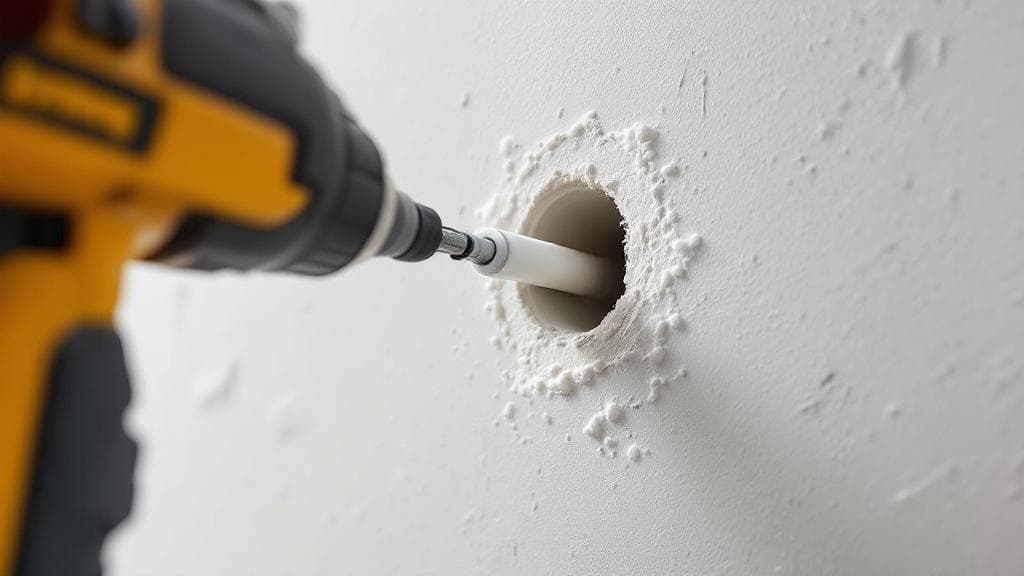
Drill-and-fill is the technique that lets a crew upgrade existing Cincinnati wall insulation without demolishing the interior wall surfaces. The crew drills a 1.5-inch access hole between studs at carefully-spaced locations (typically one per cavity), inserts a foam injection wand, dispenses closed-cell or hybrid foam to fill the cavity, then patches the access hole with a wood plug, plaster (for plaster-wall homes) or drywall mud, and color-match paint. A skilled plaster restoration specialist can make access patches invisible after final paint; a less-experienced crew leaves visible patches across every wall and devalues the architecture you are trying to preserve.
Cincinnati's pre-1995 housing stock breaks into two categories that matter for drill-and-fill. Pre-1950 plaster-wall homes (Hyde Park, Mariemont, Norwood, East Walnut Hills, Walnut Hills) have lath-and-plaster wall assemblies, often 2x4 or 2x6 framing with empty cavities or minimal historic insulation. The plaster substrate requires specialty patching to make access holes invisible. 1950s-1990s drywall homes have standard 2x4 framing with R-11 fiberglass batts in many cases. Drywall patches are cosmetically straightforward; the install mechanics are the same.
The foam choice depends on the assembly. Pure closed-cell at full cavity fill gives R-19 to R-21 in a 2x4 cavity (R-7 per inch x 2.75-inch effective fill). That is the highest-performance retrofit but requires careful injection technique to avoid blowouts. Hybrid foam (closed-cell base layer plus open-cell top-up) reduces blowout risk and delivers R-15 to R-18 in a 2x4 cavity. For Cincinnati climate, both work; the choice depends on access constraints and budget.
Pre-war plaster, midcentury fiberglass, and modern drill-and-fill scope
Cincinnati's pre-1950 stone-basement plaster-wall homes are the highest-impact drill-and-fill candidates. Many of these homes have empty wall cavities (no insulation at all in 1920s American Foursquares and Tudor-era homes) or R-7 to R-11 fiberglass batts that have settled over 60-90 years. A complete drill-and-fill upgrade brings these homes from an effective R-3 to R-11 wall assembly to R-15 to R-21 plus the air-seal benefit, which typically reduces winter heating load 25-40 percent and eliminates the cold-wall drafts that homeowners recognize as "old-house feel."
Mid-century 1950s-1970s ranches and split-levels have R-11 fiberglass batts that are usually structurally intact but lack air-seal. Drill-and-fill at hybrid foam adds R-value plus the air-seal that fiberglass alone cannot provide. The benefit is more modest than for empty-cavity pre-war homes (typical 10-20 percent heating reduction) but still meaningful, and the install is faster because plaster restoration is not needed.
Post-1995 Cincinnati construction typically already has effective fiberglass batts, vapor barriers, and reasonable air-seal at construction time. Drill-and-fill on these homes is usually unnecessary; if energy bills suggest a problem, the issue is more often air leakage at the rim joist, attic plane, or window frames rather than wall cavities. The on-site assessment uses thermal imaging to identify the actual heat-loss surfaces before quoting; we do not recommend drill-and-fill where it will not produce meaningful savings.
Cincinnati drill-and-fill cost factors and payback economics
Drill-and-fill pricing depends on cavity count, foam type, and patching scope. A typical 2,000 sqft Cincinnati pre-1950 home has 40-60 wall cavities to fill; at $200-$300 per cavity for drill-fill-patch with closed-cell foam, total project cost runs $8,000-$18,000. Smaller targeted projects (one room, one wall) can run $1,500-$3,500 if the access is simple. Whole-home drill-and-fill with full plaster restoration on a 1925 Hyde Park home typically runs $14,000-$22,000.
Energy savings depend on baseline. Empty-cavity pre-war homes typically see 25-40 percent reduction in heating cost; that runs $600-$1,200 per year savings on Cincinnati Duke Energy rates. Payback is 8-15 years on utility savings alone. Resale value uplift on Cincinnati MLS comparables suggests documented foam-insulated pre-war homes sell at modest premiums ($5,000-$15,000) that compress payback to 5-8 years if the homeowner sells in that window.
The non-financial benefits often matter more than the math suggests. Homeowners consistently report that the comfort improvement (no more cold walls, no more drafts at exterior outlets, room-to-room temperature delta dropping from 6-8 degrees to 1-2 degrees) is the most-valued outcome. Reduced thermostat fights and quieter rooms (the air-seal blocks exterior noise) consistently top the post-install survey responses. The energy savings show up on the bill; the comfort improvement shows up on the day-to-day experience of the home.
Service area
Wall Cavity Spray Foam is available across Greater Cincinnati and Northern Kentucky. Per-suburb pages: